
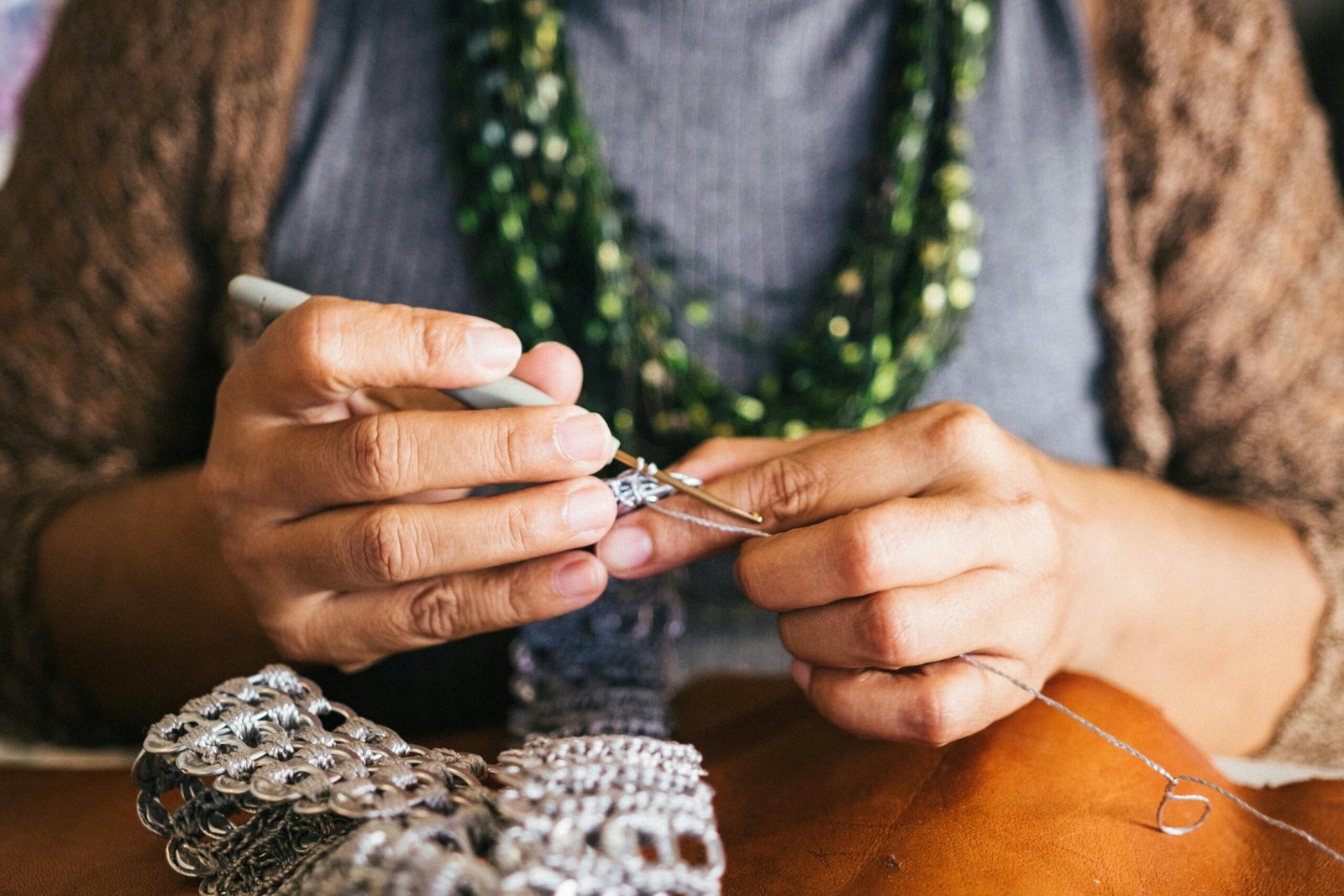
When you first start crochet or knitting, it’s easy to think the hook or needles don’t matter much—until you try to work a few rows and realize everything feels either too tight, too slippery, or awkward in your hands. Then you walk into a craft store (or browse online) and see a wall of options: aluminum hooks, ergonomic hooks, bamboo needles, metal needles, circular needles, interchangeable sets, different lengths, different tips… and suddenly choosing a simple tool feels like a whole project on its own.
Here’s the truth: you don’t need the “perfect” hook or needles to begin. But choosing a beginner-friendly set of tools can make learning dramatically easier. It helps you see stitches clearly, reduce hand strain, avoid constant splitting of yarn, and build confidence faster—because you’re not fighting your tools while trying to learn the craft.
This guide will walk you through everything you need to know to choose your first crochet hook and knitting needles: the best starter sizes, which materials are easiest to learn with, how tool choice affects tension, what to look for in comfort, and what to avoid buying too early.
Why Tool Choice Matters So Much for Beginners
Crochet and knitting are “small movement” crafts. That means tiny differences in tool shape and material can create big differences in how the craft feels.
When your tools match your yarn and your learning stage, you’ll notice:
- Stitches form more smoothly
- Your hands stay more relaxed
- Mistakes are easier to fix
- Your fabric looks more consistent
- You feel less frustrated (and more likely to keep going)
When your tools fight you—too slippery, too small, too sharp, too uncomfortable—you might blame yourself, when really the setup is simply not beginner-friendly.
The Beginner Sweet Spot: Start With Medium Tools and Medium Yarn
Before we get into materials and brands, the easiest starting point for most beginners is:
- Worsted weight yarn (#4) in a light or medium color
- Crochet hook: 5.0 mm (H/8) or 5.5 mm (I/9)
- Knitting needles: 5.0 mm (US 8) or 5.5 mm (US 9)
Why this works:
- The stitches are large enough to see clearly
- The yarn isn’t so thin that progress feels slow
- The hook/needle sizes are common and easy to find
- Many beginner patterns are written for these sizes
If you want to make learning as smooth as possible, this is the most reliable starting combo.
Crochet Hooks: What Beginners Should Know
Crochet hooks come in different sizes, materials, and handle shapes. Beginners usually struggle most with:
- tension being too tight
- yarn splitting
- difficulty inserting the hook into stitches
- hand fatigue from gripping too hard
The right hook reduces all of those.
Crochet Hook Sizes: The Best Starter Choices
Crochet hook size affects the size of the loops you create. Bigger hook = bigger loops = looser fabric. Smaller hook = smaller loops = tighter fabric.
Best beginner hook sizes for #4 yarn
- 5.0 mm (H/8): the classic beginner size
- 5.5 mm (I/9): great if you tend to crochet tight
- 6.0 mm (J/10): can be comfy for very tight crocheters, but stitches may look looser
If you’re only buying one hook to start, choose 5.0 mm. If you can buy two, choose 5.0 mm and 5.5 mm. That gives you an easy way to adjust if your tension is too tight without changing your whole technique.
Hook sizes and learning speed
- Smaller hooks (like 3.0–4.0 mm) can slow learning because stitches are smaller and harder to see.
- Very large hooks (like 8.0 mm+) can make stitches floppy and harder to control.
Medium hooks make it easier to build muscle memory and understand stitch anatomy.
Crochet Hook Materials: Aluminum, Bamboo, Plastic, and More
Hook material changes how the yarn slides and how much control you feel.
Aluminum (or other smooth metal hooks)
Why beginners often like them
- Smooth glide (hook passes through loops easily)
- Widely available and affordable
- Works well with most beginner yarns
Potential downside
- If you crochet very loosely, stitches may slip around more
- Some people grip harder because the hook feels “thin,” which can cause fatigue
Aluminum hooks are a safe beginner pick, especially when paired with smooth acrylic yarn.
Bamboo/Wood hooks
Why beginners like them
- Slightly grippy (stitches don’t slide off as easily)
- Feels warm in the hand
- Helpful if you feel out of control with a very smooth metal hook
Potential downside
- Can feel “draggy” with certain yarns
- Can slow you down slightly if you prefer a fast glide
Bamboo hooks are a great choice if you’re worried about stitches slipping or you prefer more control.
Plastic hooks
Plastic varies a lot. Some are smooth and fine, others catch yarn or feel flexible.
Beginner tip: If you’re choosing plastic, look for a hook that feels sturdy and smooth, not bendy or rough at the tip.
Steel hooks (very small)
Steel hooks are for thread crochet and very fine work—beautiful, but not ideal for beginners learning basic stitches.
Hook Shape Matters: Head Style and Yarn Splitting
Hooks aren’t all shaped the same. Two hooks can be the same size but feel totally different because of the hook head.
Why yarn splitting happens
Yarn splitting is when your hook catches only part of the yarn strand instead of the full strand. It’s common for beginners because:
- the hook tip is sharp
- the yarn is loosely twisted
- the hook head shape catches fibers
- you insert the hook at an angle
Beginner-friendly hook head traits
- A hook head that’s not too pointy
- A smooth throat area (the narrow section under the head)
- A comfortable “scoop” that grabs yarn without shredding it
If you notice constant splitting, it’s not always your technique. Sometimes it’s the hook-yarn combination.
Standard vs Ergonomic Crochet Hooks
This is one of the biggest comfort decisions.
Standard hooks
Standard hooks have a thin handle. Many beginners start with these because they’re inexpensive.
Good if:
- you crochet short sessions
- your hands don’t cramp
- you don’t grip tightly
Not ideal if:
- your thumb aches
- your fingers cramp quickly
- you squeeze the hook hard for control
Ergonomic hooks
Ergonomic hooks have thicker handles—often rubber, silicone, or shaped plastic.
Why they help beginners
- You don’t need to pinch as tightly
- Pressure spreads across your hand
- Many people feel less fatigue and wrist tension
If you can afford one ergonomic hook in a common size (like 5.0 mm), it can be a really smart purchase—especially if you know you tend to grip tightly when concentrating.
Knitting Needles: What Beginners Should Know
Knitting needles can feel even more confusing than crochet hooks because there are more variables:
- straight vs circular
- needle length
- tip sharpness
- material (wood, metal, plastic)
- interchangeable systems
- different needle styles (single-pointed, double-pointed, etc.)
The good news: beginners can start with a simple setup that works for most first projects.
Knitting Needle Sizes: The Best Starter Choices
Just like crochet, needle size affects stitch size and tension.
Best beginner needle sizes for #4 yarn
- US 8 (5.0 mm): classic beginner needle size
- US 9 (5.5 mm): great if you knit tight
- US 7 (4.5 mm): can be okay, but may feel tighter and less forgiving
If you’re buying one needle size: US 8 (5.0 mm) is the safest bet. If your knitting tends to be tight, US 9 can feel easier at the start.
Straight Needles vs Circular Needles for Beginners
Many beginners assume circular needles are “advanced.” They aren’t. You can knit flat on circular needles exactly like you would on straight needles—just with a cable connecting the needle tips.
Straight needles
Pros
- Simple and familiar
- Great for small flat practice pieces
Cons
- Can feel long and awkward
- The weight of a growing project sits on your hands
- Stitches can slide off the ends if you’re not careful
Straight needles are fine for beginners, but they’re not always the most comfortable option.
Circular needles (even for flat knitting)
Pros
- More comfortable for many people
- Project weight rests on the cable and your lap
- Less strain for wider projects
- More versatile long-term (flat or in the round)
Cons
- Cheap circular needles can have stiff cables
- There’s a small learning curve to managing the cable at first
Beginner recommendation
If you want one tool that grows with you, choose a circular needle in US 8 (5.0 mm) with a 24–32 inch cable. You can knit a scarf flat, and later you can try hats or other round projects when you’re ready.
Needle Material: Wood, Bamboo, Metal, and Plastic
Needle material affects how quickly stitches slide and how much control you feel.
Bamboo/Wood needles
Why they’re beginner-friendly
- Slight grip prevents stitches from sliding off too easily
- Encourages slower, controlled movements (great for learning)
- Comfortable and warm in the hands
Potential downside
- Can feel slower if you like fast knitting
- Tips can wear down over time if used heavily
For many beginners, bamboo is the easiest place to start.
Metal needles
Why people love them
- Very smooth and fast
- Great for experienced knitters who like speed
- Helpful when working with “grabby” yarn
Potential downside for beginners
- Stitches can slide off quickly
- Can feel slippery if your tension is inconsistent
- Might encourage anxiety gripping (you hold tighter because you fear dropping stitches)
Metal needles are not “bad” for beginners, but they’re often easier after you’re comfortable handling stitches.
Plastic needles
Plastic varies widely. Some are fine, others squeak, snag, or flex.
For beginners, plastic is okay if it’s sturdy and smooth, but many people outgrow it quickly.
Needle Tips: Blunt vs Sharp (and Why It Matters)
Needle tips affect how easy it is to insert the needle into stitches and how likely you are to split yarn.
Beginner-friendly needle tips
- Slightly rounded or moderately blunt tips
- Easy insertion without stabbing the yarn
- Less accidental splitting
Sharper tips
Sharper tips can be great for:
- lace knitting
- fine yarn
- complex stitch work
…but for beginners, sharp tips can lead to:
- yarn splitting
- poking your fingers
- tension tightening because you feel cautious
If you see “lace tips” or very sharp needles, you can skip those for now.
Needle Length: What’s Best for Beginners?
Straight needle length
Straight needles come in various lengths (9”, 10”, 14”). Longer needles hold more stitches but can feel awkward.
For beginners, medium lengths can be comfortable, but many beginners prefer circular needles for comfort anyway.
Circular cable length
Cable length affects what you can knit comfortably.
Beginner-friendly cable lengths:
- 24 inches: good for flat knitting and some hats
- 32 inches: great for flat knitting (scarves, blankets)
- 16 inches: mostly for hats in the round (later)
If you’re buying one circular needle, 24–32 inches is the most versatile.
Interchangeable Needle Sets: Should Beginners Buy Them?
Interchangeable sets (where you switch needle tips and cables) are tempting because they look like the “ultimate solution.” But they’re usually not necessary when you’re just starting.
When an interchangeable set makes sense
- You already know you love knitting
- You’ve finished multiple projects
- You want to explore many yarn weights and patterns
- You’ve learned which material you like (wood or metal)
When it’s smarter to wait
- You’re still learning basics
- You don’t know your preferred sizes
- You’re not sure how often you’ll knit
A beginner strategy that saves money: buy one circular needle in US 8 and make a couple projects first.
Matching Yarn to Tools: The “Label Guidelines” (And Why You Can Bend Them)
Most yarn labels suggest:
- a crochet hook size range
- a knitting needle size range
These suggestions are a starting point. They’re not strict rules.
Why you might use a different size than the label suggests
- You crochet/knit tighter or looser than average
- You want a stiffer fabric (bag, basket)
- You want a drapier fabric (scarf, shawl)
- The pattern requires specific gauge
For beginners, the easiest approach is:
- Start with the label suggestion
- Adjust one size up or down if it feels too tight or too loose
The Beginner Comfort Triangle: Tool Size, Yarn, and Tension
If something feels hard, don’t assume you lack skill. Check your triangle:
- Is the hook/needle size too small for my tension?
- Is the yarn hard to work with (fuzzy, splitty, dark)?
- Am I gripping too tightly because I’m nervous?
Often, the simplest fix is tool size. Going up one hook/needle size can instantly make stitches easier to form.
What to Avoid Buying as a Beginner
It’s not that these tools are bad—it’s just that they usually make learning harder or cause unnecessary spending.
1) Very small hooks/needles
Thin yarn and tiny tools slow progress and hide stitch structure. Save them for later.
2) Very slippery tools paired with slippery yarn
If you combine metal needles with super slick yarn as a beginner, you may spend your time catching dropped stitches instead of learning.
3) Novelty “starter kits” with random sizes
Some kits include lots of sizes you won’t use for months, plus low-quality tools. It’s often better to buy one good hook/needle size and one good yarn.
4) Huge sets “just in case”
Beginners often use one or two sizes for a long time. Start small and upgrade later.
How to Choose Tools Based on What You Want to Make
Different projects feel better with different tool traits.
If you want to crochet amigurumi (toys)
You’ll usually use:
- a smaller hook than the label suggests
- tighter stitches to avoid gaps
Beginner-friendly recommendation:
- start with smooth yarn that doesn’t split
- choose a hook that feels comfortable and doesn’t snag
- consider ergonomic handles because tight crochet can cause hand fatigue
If you want to crochet scarves and blankets
You’ll want:
- a hook that glides smoothly
- a size that gives good drape (often label size or slightly larger)
If you want to knit scarves and dishcloths
Beginner-friendly:
- bamboo/wood needles to prevent slipping
- US 8 or US 9 needles with worsted yarn
If you want to knit hats later
A circular needle becomes useful:
- 16” circular for hats (later)
- or learn “magic loop” with a longer cable (later)
But you don’t need hat needles on day one.
A Simple “Beginner Buyer’s Plan” (No Overthinking)
If you want a clean shopping plan that works for almost everyone:
For crochet beginners
- 1 hook: 5.0 mm (ergonomic if possible)
- 1 extra hook (optional): 5.5 mm
- smooth worsted yarn (#4), light color
- yarn needle + scissors
For knitting beginners
- 1 circular needle: US 8 (5.0 mm), 24–32 inch cable (bamboo/wood recommended)
- smooth worsted yarn (#4), light color
- yarn needle + scissors
- stitch markers (optional)
With that, you can make swatches, dishcloths, scarves, headbands, and more—without buying a mountain of gear.
How to Tell If Your Tools Are Working for You
After 20–30 minutes of practice, ask yourself:
- Am I fighting to insert my hook/needle into stitches? (too tight or tool too small)
- Are stitches sliding off constantly? (too slippery, or you need more control)
- Is my hand cramping or thumb sore? (try ergonomic hook, adjust grip, take breaks)
- Is yarn splitting constantly? (yarn type, hook/needle tip shape, or insertion angle)
- Do I feel calm and in control? (that’s the goal)
If you feel like you’re constantly struggling, a tool change can help more than forcing more practice with uncomfortable gear.
Smart Upgrades After You Finish a Few Projects
Once you’ve completed a couple of projects, you’ll know your preferences. Then upgrades actually make sense.
Crochet upgrades
- ergonomic hook set (if comfort is a big deal)
- a range of sizes for different yarn weights
- better-quality hooks if you notice snagging or rough tips
Knitting upgrades
- a second circular needle size (for DK or bulky projects)
- higher-quality circular needles with smooth cable joins
- eventually, an interchangeable set if you knit often
Upgrade based on what you actually make, not what looks “professional.”
Building Confidence With the Right Tools
Choosing beginner-friendly hooks and needles doesn’t mean you’re taking shortcuts. It means you’re making learning easier so you can focus on the real goal: building skill, finishing projects, and enjoying the process.
Start with medium yarn and medium tools. Choose materials that give you control (wood/bamboo) or glide (aluminum/metal) depending on what feels better. Prioritize comfort and visibility, not fancy gear. And remember: if something feels hard, adjust your tool size before you assume you’re the problem.
Isabella Garcia is the creator of a blog dedicated to crafts and home care, focused on making everyday life more creative, organized, and enjoyable. The blog shares practical tips, easy DIY projects, home organization ideas, and simple solutions to take better care of your living space. Whether you’re a beginner in crafting or someone looking for inspiration to improve your home routine, Isabella’s blog offers clear, useful, and hands-on content to help you create a cozy, beautiful, and well-cared-for home.