
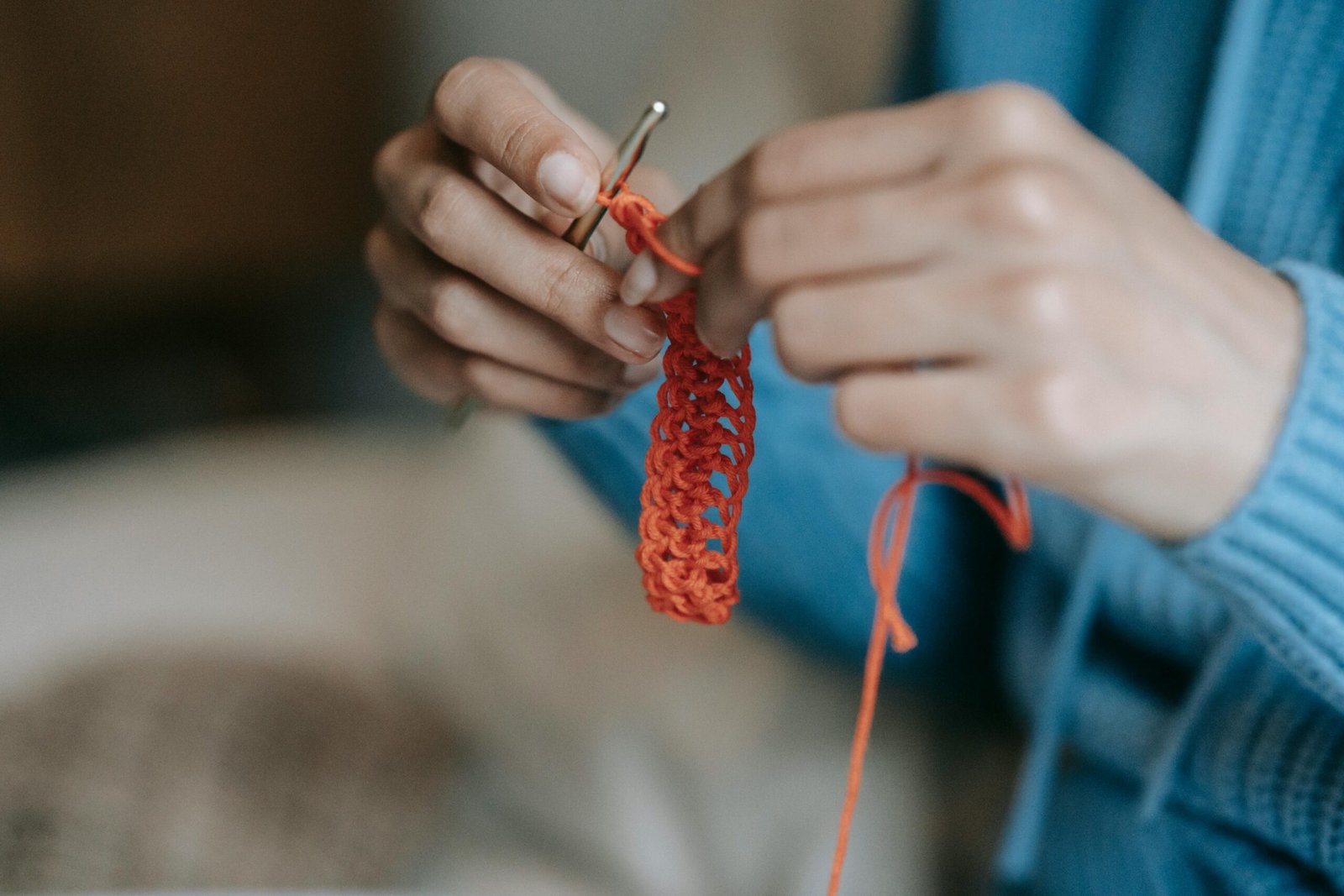
Knitting is one of those skills that looks effortless in someone else’s hands—and feels a little chaotic in yours at the beginning. Stitches slip, tension changes, and you might wonder how anyone turns string into a sweater on purpose. The good news is that knitting isn’t hard because it’s complicated. It’s hard because it’s new. Your hands are learning a fresh set of movements, and that takes a bit of repetition.
This beginner guide is designed to get you knitting with confidence and finishing something real. You’ll learn what to buy (without overspending), how to cast on, how to knit and purl, how to fix common mistakes, and how to complete a first project that looks neat enough to be proud of.
What Knitting Is, in Plain Language
Knitting creates fabric by forming loops (stitches) and moving them from one needle to the other. Each row builds on the row before it. The stitches stay “alive” on your needle until you bind them off at the end.
A helpful way to think about it:
- Casting on puts stitches on the needle.
- Knit and purl are the two foundational stitches.
- Binding off closes the stitches so the fabric won’t unravel.
With just those three skills, you can already make scarves, dishcloths, headbands, simple blankets, and practice swatches that teach you everything you need for bigger projects later.
The Best Knitting Supplies for Absolute Beginners
You don’t need a full set of needles or luxury yarn to start well. A simple setup makes learning easier.
Yarn: Choose “Beginner Mode”
Look for yarn that’s:
- Worsted weight (#4 / Medium) (easy to see and control)
- Smooth (no fuzz, fluff, or eyelash textures at first)
- Light or medium color (dark yarn hides stitches)
- Acrylic, wool-acrylic blend, or smooth wool (forgiving and common)
Avoid, at least for your first month:
- Very thin yarn (hard to see stitches)
- Very slippery yarn (hard to keep on needles)
- Novelty textures (hard to “read” your work)
If you want the easiest experience, choose a smooth, medium acrylic in a light shade. It’s inexpensive and perfect for learning.
Needles: The Best Beginner Choice
For beginners, these are the sweet spot:
- US 8 (5 mm) or US 9 (5.5 mm)
Material matters too:
- Bamboo/wood needles grip yarn slightly and reduce slipping (great for beginners).
- Metal needles can be faster, but stitches slide more easily.
Needle type:
- Straight needles are simple and common for scarves and flat practice.
- Circular needles can be used for flat knitting too, and they hold stitches securely.
If you’re choosing one option: a pair of US 8 bamboo straight needles is a very safe start.
Helpful Extras (Optional, But Nice)
- Tapestry needle (to weave in ends)
- Small scissors (use carefully and store safely)
- Stitch markers (or paper clips)
- Measuring tape (optional)
That’s enough to begin.
How to Hold Your Yarn: English vs Continental
People knit in different styles depending on how they hold the yarn. Both are correct.
English Style (Throwing)
- Yarn stays in your right hand
- You “wrap” the yarn around the needle
Many English-style beginners find the motions clearer at first because the steps are obvious.
Continental Style (Picking)
- Yarn stays in your left hand
- You “pick” the yarn with the needle tip
Continental can feel smoother once you get used to it, but it’s also totally fine if it feels weird at first.
Try both for five minutes each. Choose the one that makes you feel more in control. Comfort beats imitation.
Casting On: The Beginner-Friendly Way
Casting on is how you get stitches onto your needle. There are many methods, but beginners do best with ones that are easy to understand.
Option 1: Knitted Cast On (Easy to Learn)
This method basically uses the knit stitch to create new stitches. It’s not the fastest, but it’s very logical.
- Make a slip knot and place it on the left needle.
- Insert the right needle into the slip knot as if to knit.
- Wrap yarn, pull a new loop through.
- Place that new loop onto the left needle (that becomes a new stitch).
- Repeat until you have the number of stitches you need.
If you’re brand new, start here. It teaches you how stitches form.
Option 2: Long-Tail Cast On (Great Once You’re Ready)
Long-tail cast on creates a nice, stretchy edge, but it takes practice to coordinate both strands of yarn. If you feel ready, it’s a great next skill. If not, use knitted cast on first—no shame, and it works beautifully.
The Knit Stitch (K): Your First Core Skill
The knit stitch is the foundation of many beginner projects. If you knit every row, you create garter stitch, a bumpy, cozy fabric that lies fairly flat and doesn’t curl much.
Basic knit stitch steps:
- Hold the needle with stitches in your left hand.
- Insert the right needle into the first stitch from front to back.
- Wrap yarn around the right needle.
- Pull the new loop through the stitch.
- Slide the old stitch off the left needle.
At first, do it slowly and clearly. Speed is not the goal. Smooth, consistent movement is.
The Purl Stitch (P): The Twin of Knit
Purl looks like knit’s opposite. When you combine knits and purls, you unlock a huge portion of knitting patterns.
Basic purl steps:
- Bring yarn to the front of the work.
- Insert the right needle into the first stitch from back to front.
- Wrap yarn around the right needle.
- Pull the loop through.
- Slide the old stitch off.
The purl stitch can feel awkward at first. That’s normal. Your hands will adapt quickly with a little repetition.
Garter Stitch vs Stockinette (And Why Beginners Should Start With Garter)
Garter Stitch
- Knit every row (or purl every row)
- Texture is bumpy on both sides
- Fabric is thicker and lies flatter
- Great for scarves, blankets, dishcloths
Stockinette Stitch
- Knit one row, purl the next
- Smooth “V”s on one side, bumps on the other
- Fabric curls at the edges without a border
Beginners often jump into stockinette and get frustrated by curling edges. That’s why garter stitch is such a solid first project fabric.
Tension: The Skill That Improves Automatically (If You Don’t Fight It)
Tension is how tight your yarn is as you form stitches. Most beginners knit too tightly because they’re trying to control everything.
If your stitches are too tight:
- Use a slightly bigger needle
- Relax your grip
- Don’t pull the yarn after every stitch
- Make sure stitches sit on the thicker part of the needle, not the sharp tip
If your stitches are too loose:
- Keep yarn path consistent across your fingers
- Slow down
- Focus on forming each new loop the same way
Your tension will improve faster than you expect—usually within a few practice sessions.
Reading Your Knitting: Spotting Stitches and Rows
Being able to “read” your knitting makes you calmer, because you understand what you’re seeing.
- Knit stitches look like little V shapes (on the smooth side of stockinette).
- Purl stitches look like small bumps.
- In garter stitch, you see horizontal ridges (rows of bumps) on both sides.
Even in garter stitch, you can count rows by counting ridges. That’s a great beginner skill for measuring progress.
The Most Common Beginner Mistakes (and Fixes)
“My scarf is getting wider.”
You might be accidentally increasing stitches. This often happens if you:
- Knit into the yarn between stitches
- Mistake the edge loop for two stitches
Fix:
- Count your stitches every 2–4 rows.
- Learn what your edge stitch looks like.
- Move slowly at the beginning and end of the row.
“My scarf is getting narrower.”
You might be dropping stitches at the edges.
Fix:
- Make sure you knit the last stitch of each row.
- Avoid knitting too close to the needle tip.
- If you pause, slide stitches away from the tip so they can’t slip off.
“I dropped a stitch.”
A dropped stitch is when a loop falls off the needle. It’s common and fixable.
Beginner approach:
- If you see it immediately and it’s near the top, you can often pick it back up and place it on the needle.
- If it fell several rows down, you can use a crochet hook (or the needle tip) to pull the loop back up through the ladder of yarn.
If that sounds confusing, don’t panic. For your first project, even if you can’t fix it perfectly, you can secure it later with a yarn needle and keep going. The goal is finishing and learning.
“My edges look messy.”
Edges are messy for everyone at the start. A simple trick can help:
Slip the first stitch of every row.
How:
- Move yarn to the front if needed, then slip the first stitch from left needle to right needle without knitting it.
- Knit the rest of the row as normal.
This creates a cleaner, chain-like edge. Just do it consistently on every row if you choose that method.
Your First Project: A Garter Stitch Scarf
A garter stitch scarf is one of the best first projects because it:
- Uses only the knit stitch
- Is easy to memorize
- Doesn’t curl much
- Builds even tension through repetition
Materials
- Worsted weight yarn (smooth)
- US 8 (5 mm) needles
- Tapestry needle
- Scissors
Choosing Width and Stitch Count
A comfortable beginner scarf width is often 6–8 inches (15–20 cm).
With worsted yarn and US 8 needles, a good starting stitch count is:
- 24 stitches for a medium scarf
- 20 stitches for a slimmer scarf
- 28 stitches for a wider scarf
If you don’t know what to pick: cast on 24 stitches.
Pattern: Simple Garter Stitch Scarf
- Cast on 24 stitches (knitted cast on is fine).
- Row 1: Knit every stitch across.
- Turn your work.
- Row 2: Knit every stitch across.
- Repeat Row 2 until the scarf reaches your preferred length.
- Bind off.
- Weave in ends.
That’s the whole scarf: knit every row.
How Long Should You Make It?
A classic scarf length for many people is about 55–70 inches (140–180 cm), but you can choose what feels right:
- Short scarf: 45–55 inches
- Standard scarf: 55–70 inches
- Extra cozy: 70+ inches
If you’re impatient (fair!), make a shorter scarf first and celebrate finishing.
Binding Off: Finishing Without a Tight Edge
Binding off closes your live stitches so the fabric can’t unravel.
Basic bind off:
- Knit two stitches.
- Use the left needle tip to lift the first stitch over the second stitch and off the needle.
- Knit one stitch.
- Lift the previous stitch over it.
- Repeat until one stitch remains.
- Cut yarn and pull through the last stitch.
Beginner warning: binding off too tightly is common.
To keep it relaxed:
- Bind off gently without tugging hard.
- Or bind off using a needle one size larger.
Weaving in Ends (So Your Work Stays Secure)
Weaving in ends is what makes a finished project durable.
Steps:
- Thread your yarn tail onto a tapestry needle.
- Weave through several stitches along the edge (about 1–2 inches).
- Change direction and weave back through a different path.
- Trim excess.
Changing direction helps lock the yarn in place.
A Second Beginner Project (Optional): A Simple Knit Dishcloth
If you want something faster than a scarf, dishcloths are perfect practice. They are small, useful, and you can finish one in a day or two.
Basic idea:
- Cast on about 30 stitches with cotton yarn and US 7–8 needles
- Knit every row until it’s a square
- Bind off and weave in ends
Cotton yarn can feel less stretchy than acrylic, but it makes great dishcloths and helps you practice consistent tension.
How to Practice Without Getting Overwhelmed
A simple plan works better than marathon sessions.
Try this schedule:
- 10 minutes of knit stitch practice each day
- Focus on consistent loops, not speed
- After a week, try a small project
If you want a clear milestone:
- Day 1–2: Cast on and knit rows
- Day 3–4: Learn purl and make a small stockinette swatch
- Day 5–7: Start a scarf or dishcloth and stick with it
Finishing one project teaches you more than starting five.
Caring for Your Finished Knitting
Care depends on yarn type:
- Acrylic: usually machine washable (check label)
- Wool: often needs gentle washing and drying flat
- Cotton: often washable, can stretch if hung wet
When in doubt:
- Wash in cool water
- Avoid aggressive wringing
- Dry flat to maintain shape
A Strong “Beginner Knitter” Checklist
If you can do these, you’re officially knitting:
- Cast on without panicking
- Knit a row without dropping stitches constantly
- Recognize when you’ve added or lost stitches
- Bind off with a reasonably even edge
- Weave in ends cleanly
Your stitches don’t need to be perfect to be real knitting. They just need to exist—and with practice, they’ll get smoother.
The Next Skill to Learn After You Finish
Once you’ve completed your first scarf or dishcloth, the next skills that unlock more patterns are:
- The purl stitch (if you haven’t learned it yet)
- Ribbing (knit 1, purl 1; knit 2, purl 2)
- Simple increases and decreases
- Circular needles (for hats and seamless projects)
But don’t rush. Knitting is a craft where consistency builds confidence fast.
Isabella Garcia is the creator of a blog dedicated to crafts and home care, focused on making everyday life more creative, organized, and enjoyable. The blog shares practical tips, easy DIY projects, home organization ideas, and simple solutions to take better care of your living space. Whether you’re a beginner in crafting or someone looking for inspiration to improve your home routine, Isabella’s blog offers clear, useful, and hands-on content to help you create a cozy, beautiful, and well-cared-for home.